
This is part of an ongoing series of state-by-state guides to verifying resale certificates. New York warrants specific attention as it has one of the strictest sales tax enforcement regimes in the country, maintaining a zero-tolerance approach for invalid exemptions. You can find the full list of articles here: The Resale Certificate Problem Across the US.
In New York, the burden of proving that any sale is not taxable is entirely upon the seller. If you accept an invalid or improperly completed resale certificate, the New York State Department of Taxation and Finance will hold you responsible for the uncollected tax, plus substantial interest and penalties.
This guide walks you through exactly how to verify a New York Sales Tax Certificate of Authority number manually using the state’s official Registered Sales Tax Vendor Look Up portal.
The Legal Standard: “Good Faith” and 90 Days
Under New York Tax Law § 1132(c)(1), all gross receipts are presumed subject to tax until the contrary is established. A seller is relieved of the obligation to collect sales tax if they accept a properly completed exemption certificate in good faith.
Timely Acceptance (The 90-Day Rule)
In New York, an exemption certificate is only considered accepted in good faith if it is accepted within 90 days of the delivery of the property or the rendition of the service. Certificates accepted after 90 days are subject to intense scrutiny, and the burden of proof becomes significantly harder to meet during an audit.
In an audit, the burden of proof is on the seller. The Department will verify:
- The Certificate: A fully completed Form ST-120 (Resale Certificate).
- The Verification: Evidence that the purchaser’s 9-digit Certificate of Authority number was active on the date of the sale.
What You Need Before You Start
- The purchaser’s 9-digit Sales Tax Identification Number (Certificate of Authority number).
- The purchaser’s legal business name (for cross-referencing).
- Access to the New York Registered Sales Tax Vendor Look Up portal .
description How to Verify a New York Resale Certificate Manually
3 Steps 3 minutes Created by ExemptCheck
How to Verify a New York Resale Certificate Manually
Pro-Tip:
New York Sales Tax Identification numbers are always 9 digits.
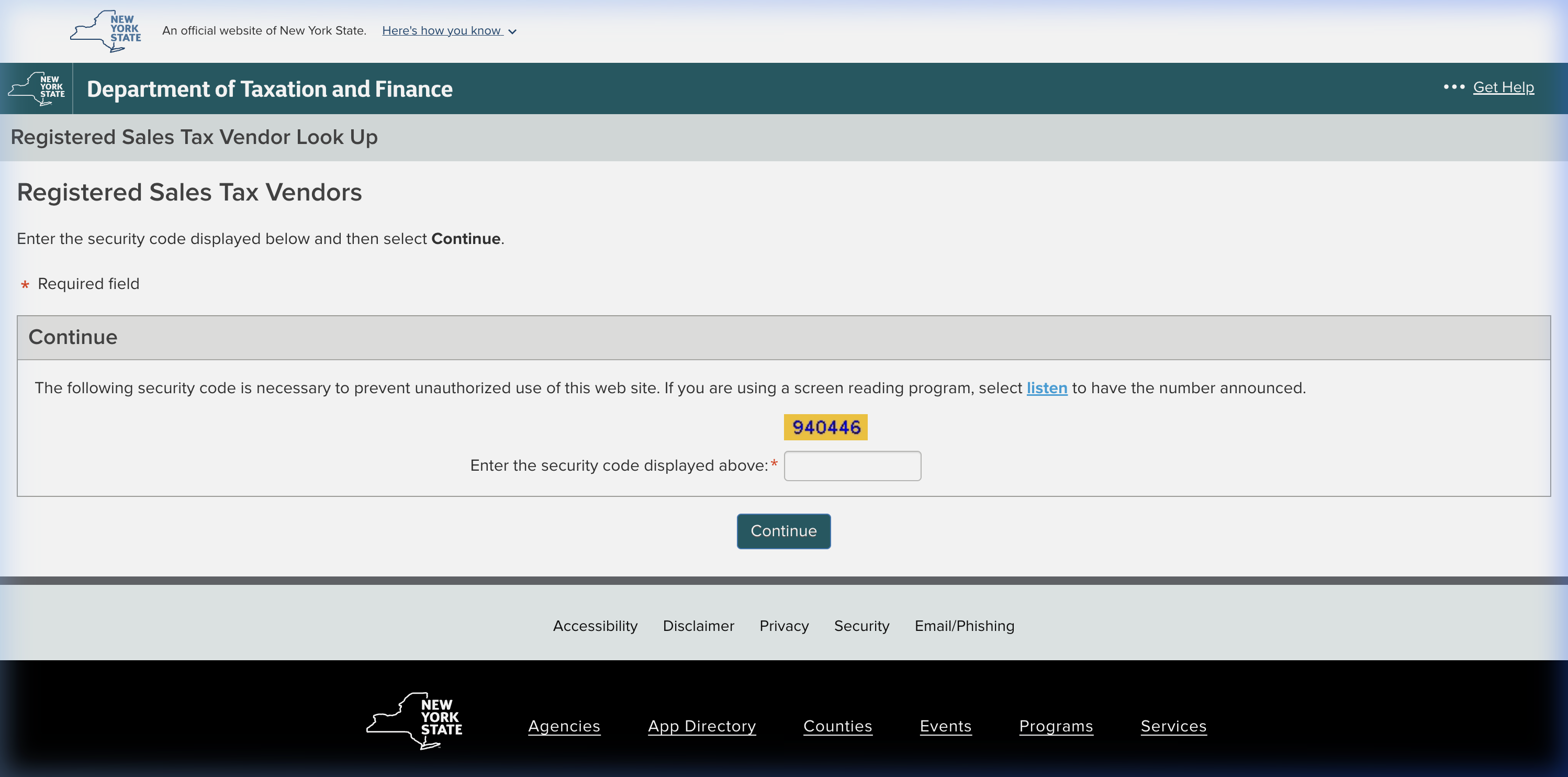
The NY Department of Taxation and Finance provides a public portal. You will first need to solve a CAPTCHA to access the search form.
Enter the Certificate of Authority Number
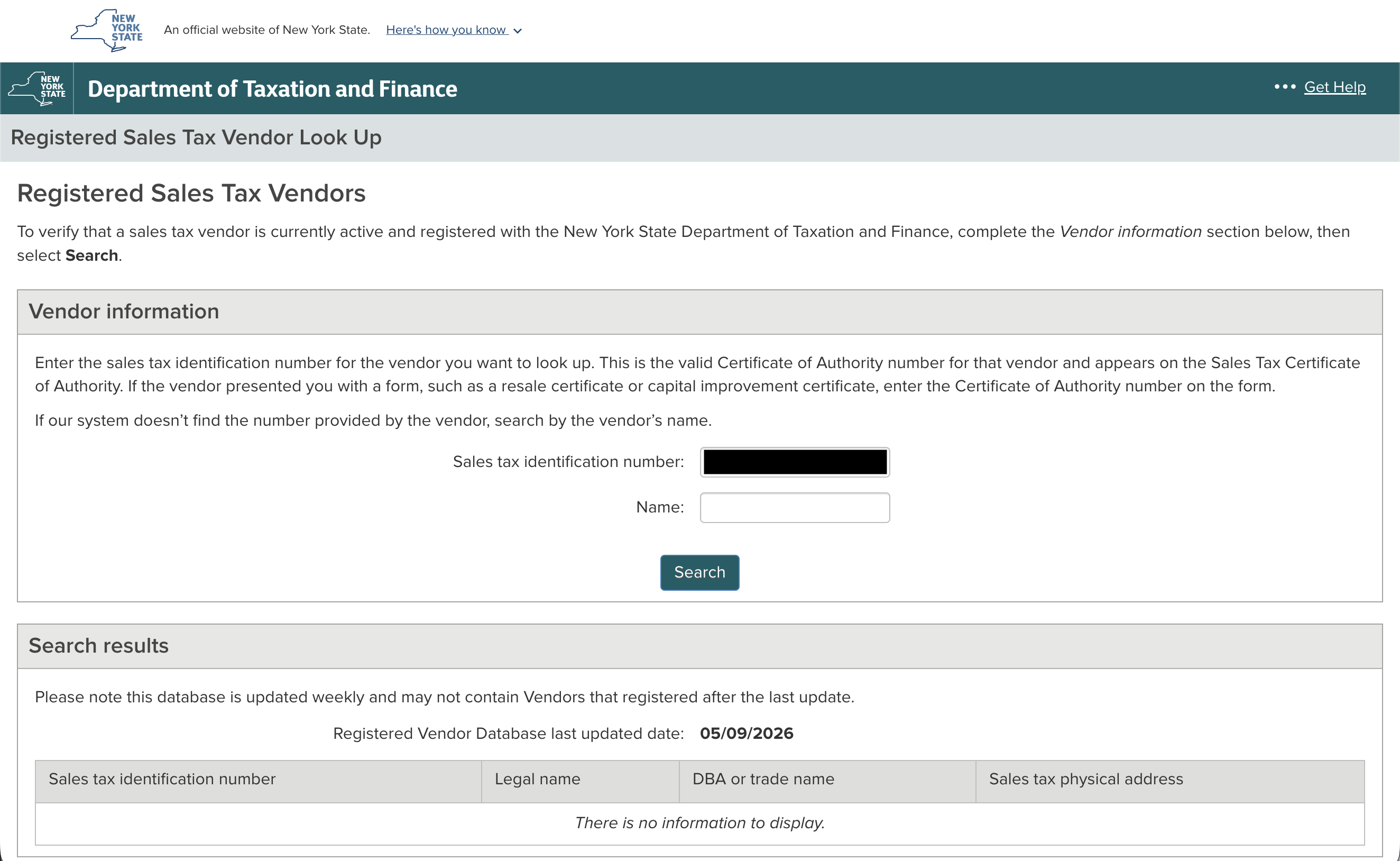
Type the 9-digit number into the ‘Sales tax identification number’ field. You do not need to enter the name if you have the number.
Analyze the Search Results
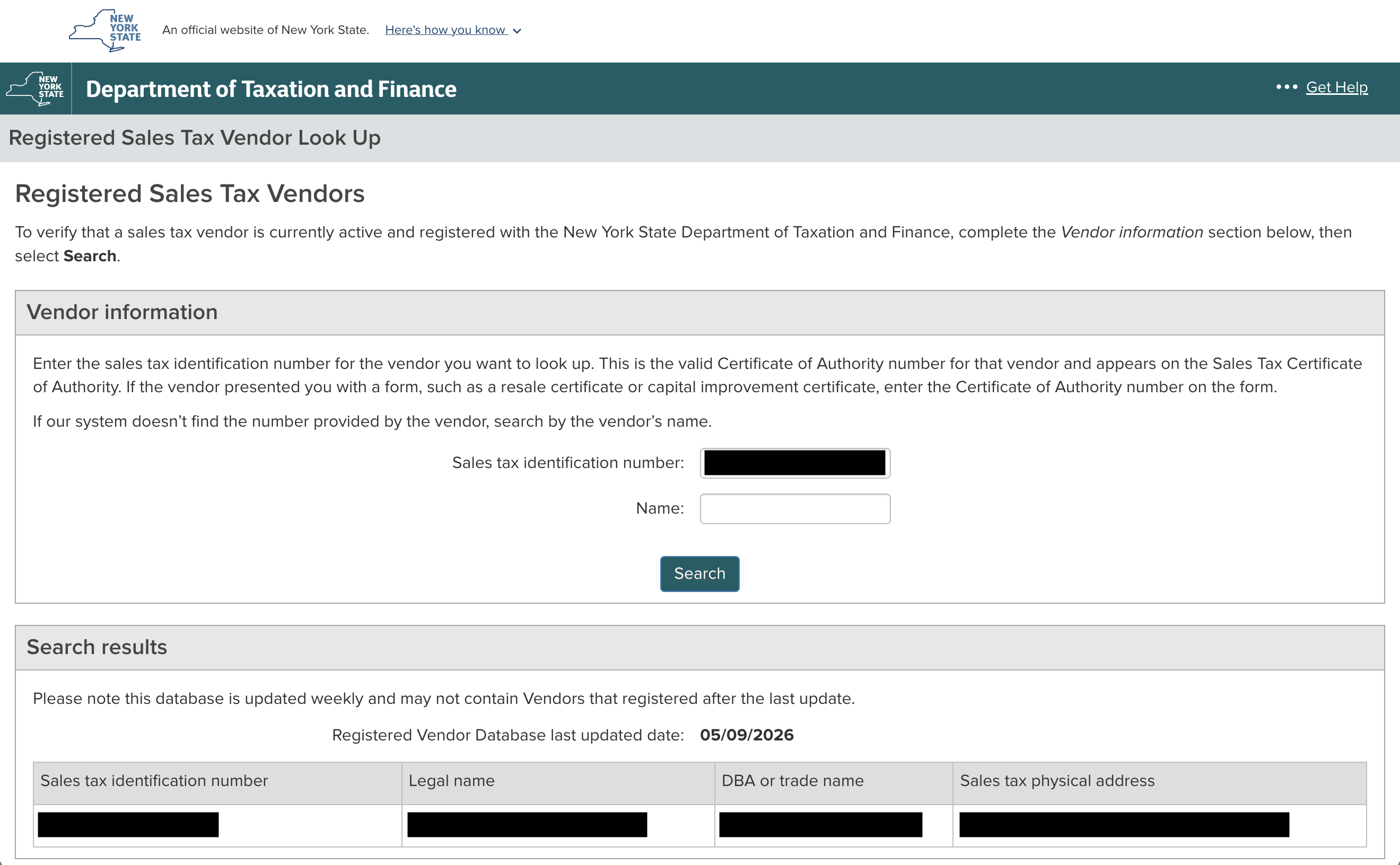
Review the results table. If the database returns a matching record with the correct Legal Name and DBA, the vendor is actively registered. Capture a screenshot of this page for your audit records. If the portal returns “No Records Found”, the certificate is invalid and you must collect sales tax.
Understanding the New York Result Data
The New York portal provides several critical data points that should be cross-referenced with the ST-120 form provided by the buyer:
| Data Point | Audit Significance |
|---|---|
| Legal Name | Must match the business name on the resale certificate exactly. |
| DBA or trade name | Helpful for identifying businesses operating under a different storefront name. |
| Sales tax physical address | Confirms the physical nexus and location of the business. |
What Makes a New York Certificate Valid?
A document is only a valid New York resale certificate if it is a completed Form ST-120 containing:
- Purchaser Information: Legal name and address of the purchaser.
- Certificate of Authority Number: The 9-digit New York sales tax ID.
- Description of Items: A description of the primary nature of the business and the specific items being purchased for resale.
- Signature & Date: A valid signature from the purchaser and the date of issuance.
Common Mistakes to Avoid in New York
1. Missing the 90-Day Window
New York is incredibly strict about the 90-day rule. If you realize during an internal audit that you are missing a certificate for a past sale, obtaining one after 90 days may not protect you. The state requires additional evidence to prove the transaction was actually exempt if the certificate was not collected contemporaneously.
2. Accepting Out-of-State Certificates
Unlike some states that are members of the SSUTA, New York is not a full member and has strict rules regarding out-of-state purchasers. Out-of-state purchasers who do not have a NY Certificate of Authority may be able to use Form ST-120 if they are registered in their home state, but they must meet specific criteria. Never assume an out-of-state ID is automatically valid for a drop-shipment in NY.
3. Blanket Certificates Expiration
Blanket certificates (covering multiple purchases of the same type of property) do not technically expire in New York, but they are only valid as long as the purchaser remains registered and the information on the certificate remains accurate. Best practice dictates requesting refreshed blanket certificates every 3-4 years.
The Auditor’s Perspective: Extrapolation Risk
Like Texas, New York auditors rely heavily on statistical sampling. If they find a small sample of transactions with invalid or missing certificates, they will calculate an error rate and project that tax liability across your entire gross revenue for the audit period (typically 3 years, but up to 6 if significant underreporting is suspected). A single unverified exemption can lead to a massive assessment.
Official Sources & Further Reading
- New York Tax Law § 1132(c): Presumption of Taxability
- TB-ST-740: Exemption Certificates for Sales Tax (Tax Bulletin)
- Form ST-120: Resale Certificate (PDF)
- New York Taxpayer Search: Official Registered Sales Tax Vendor Look Up
account_balance The State-by-State Verification Series
ExemptCheck is mapping the complexities of US sales tax compliance. This technical guide is part of our ongoing series designed to equip tax professionals and finance teams with the actionable intelligence required to perform rigorous, audit-defensible certificate verification across all 50 states.
To see the full list of state guides in this series, visit: The Resale Certificate Problem Across the US .